top of page
Digital Twins & Simulation for Smarter, Predictive, Real-World Decision Making

Transform complex physical systems into intelligent virtual environments that simulate, predict, and optimize real-world performance. Our Digital Twins & Simulation solutions help organizations model operations, reduce risk, enhance productivity, and accelerate innovation through next-generation 3D and AI technologies.
WHY CHOOSE US FOR AI & DATA SOLUTIONS?
Deep Industry Expertise
Our teams understand how AI applies differently across sectors — from predictive analytics in logistics to NLP in customer service and computer vision in manufacturing. This domain-first mindset ensures every model we deliver solves a real business challenge, not just a technical one.
Custom-Built, Not Off-the-Shelf
Every solution is tailored to your data ecosystem, workflows, and performance goals. We design proprietary models rather than relying on generic APIs, giving you full control, scalability, and differentiation.
End-to-End Capability
We handle the entire journey — data engineering, model development, deployment, and MLOps integration. Our teams ensure seamless collaboration between AI systems and your existing applications, infrastructure, and teams.
Assured ROI & Long-Term Partnership
Our success is measured by your outcomes — reduced costs, faster decision cycles, and new revenue streams. We stay engaged beyond delivery, continuously optimizing models for accuracy, performance, and sustainability.
1. Digital Twin Development
We build dynamic digital replicas of physical assets, processes, or environments that sync with real-time data. Digital twins enable organizations to visualize performance, simulate outcomes, and optimize operations using predictive insights.
Asset-Level Digital Twins
Create virtual replicas of equipment or machinery with live sensor integration to monitor performance, detect anomalies, and predict failures.
Process Twins for Operations
Model entire operational workflows to identify inefficiencies, optimize resource allocation, and improve throughput in real time.
Facility & Plant Twins
Simulate and manage manufacturing plants, warehouses, or transport hubs through detailed 3D layouts and telemetry integration.
City & Infrastructure Twins
Build large-scale digital replicas of utilities, roads, and public infrastructure to support urban planning and environmental modeling.
IoT-Embedded Twins
Connect IoT sensors and data streams for real-time feedback loops that reflect real-world behavior instantly inside the digital twin.
Simulation-Driven Optimization
Run AI-powered simulations within the twin to test changes, compare scenarios, and recommend the most efficient outcomes.
Our Approach
Step 1
Map the physical system, data sources, and simulation goals.
Step 2
Build 3D models and integrate sensor or telemetry data pipelines.
Step 3
Implement real-time synchronization, analytics layers, and predictive logic.
Step 4
Deploy dashboards, monitoring tools, and optimization controls for end-users.
.png)
2. 3D Simulation & Scenario Modeling
We develop immersive simulation environments that allow organizations to test scenarios, train teams, and validate strategies in a risk-free digital space. Our simulations combine physics engines, AI agents, and real-world data for accurate modeling.
Operational Scenario Simulations
Test logistics, manufacturing flows, or emergency responses using realistic, physics-driven digital environments.
Behavioral & Agent Simulations
Simulate human or autonomous agent behavior to optimize layouts, customer journeys, or navigation.
Risk & Safety Simulations
Model hazardous conditions to assess risk mitigation strategies without exposing workers to danger.
Environmental & Spatial Simulations
Simulate heat, air flow, crowd movement, or spatial interactions for architecture, safety, and design optimization.
Product Interaction Simulations
Test how users interact with physical or digital products in virtual scenarios before production.
Decision Support Simulations
Combine data models with simulation engines to test “what-if” scenarios and forecast impacts of strategic decisions.
Our Approach
Step 1
Identify simulation objectives, variables, and constraints.
Step 2
Build 3D simulation environments using physics and behavioral engines.
Step 3
Integrate AI models for prediction, automation, and real-world alignment.
Step 4
Validate accuracy and deploy simulations for training, testing, or planning.
.png)
3. AR/VR Training & Immersive Experiences
We create immersive AR/VR training systems that allow employees to learn complex procedures in a safe, controlled, and highly interactive environment. These experiences boost retention, reduce risk, and accelerate workforce readiness.
Virtual Training Simulations
Teach technical skills or emergency protocols through immersive, hands-on digital experiences.
VR Safety & Compliance Modules
Simulate hazardous environments to train workers on safety procedures without real-world exposure.
AR Assisted Operations
Provide real-time guidance to frontline workers through augmented overlays and step-by-step instructions.
Interactive Learning Environments
Gamify training with realistic tasks, scoring, and progress tracking to improve engagement.
Soft-Skills & Communication Training
Use digital avatars and conversational AI to train teams on leadership, negotiations, and customer service.
Remote Training & Collaboration
Enable distributed teams to train together or collaborate virtually regardless of physical location.
Our Approach
Step 1
Define learning objectives and user roles for the training.
Step 2
Develop immersive 3D environments and interactive learning scenarios.
Step 3
Integrate AR/VR hardware, controls, and analytics dashboards.
Step 4
Deploy modules with tracking, assessment, and continuous improvement options.
.png)
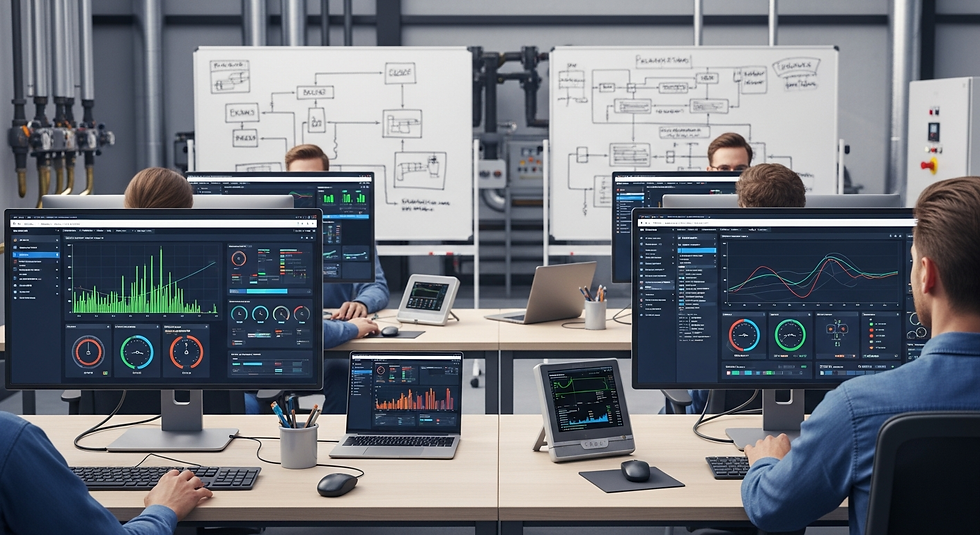
4. Process Optimization & Predictive Maintenance
We use simulation, AI analytics, and real-time monitoring to identify operational inefficiencies and predict equipment faults before they occur. This enables organizations to minimize downtime and maximize asset performance.
Predictive Failure Analysis
Identify early signs of equipment degradation to prevent costly breakdowns and reduce operational risks.
Maintenance Scheduling Optimization
Use AI-driven models to schedule maintenance based on actual condition instead of fixed intervals.
Real-Time Asset Monitoring
Track live sensor data to detect fluctuations, anomalies, or inefficiencies instantly.
Performance Benchmarking Models
Compare asset performance across time or locations to find improvement opportunities.
Network Security Architecture
Pinpoint delays, workflow interruptions, or mismatched resource allocation in real time.
Digital Logbooks
Create dynamic maintenance histories and asset records connected directly to digital twins.
Our Approach
Step 1
Gather sensor data, asset history, and operational KPIs.
Step 2
Develop predictive models and monitoring dashboards.
Step 3
Integrate real-time data streams and alert systems.
Step 4
Optimize maintenance plans and automate insights for continuous improvement.
.png)
5. Virtual Prototyping & Product Visualization
We build detailed 3D product prototypes that allow teams to visualize, test, and refine designs before manufacturing. This reduces cost, accelerates development, and improves collaboration across departments.
3D Product Prototyping
Create accurate digital replicas of products for early testing, iteration, and visualization.
Design Validation Simulations
Test structural integrity, ergonomics, and design choices using physics-based simulations.
Interactive Product Demos
Allow stakeholders to explore and interact with product concepts in virtual environments.
Photorealistic Rendering
Generate high-quality renders for presentations, marketing, or stakeholder approval.
Material & Texture Simulation
Model how surfaces, finishes, and materials behave under different conditions.
Collaborative Review Tools
Enable multi-team, remote review sessions where stakeholders analyze designs together.
Our Approach
Step 1
Import CAD files or create 3D models based on design specifications.
Step 2
Build product simulations with physics, materials, and real-world constraints.
Step 3
Enable interaction, visualization, and multi-user review capabilities.
Step 4
Iterate based on feedback and export final-ready models or reports.
.png)
bottom of page